
Affiliate disclosure: This post contains affiliate links. If you buy through them, PhysioGain may earn a small commission at no extra cost to you. I only list products I would be comfortable suggesting to my own patients. This guide is general information and not a substitute for a proper assessment.
One complaint I hear a lot from my older patients goes like this: “Doctor, the knee cap is fine, but I cannot pull it up over my foot.” Tugging a tight sleeve past the ankle and calf is honestly hard work if your back is stiff or your hands are weak.
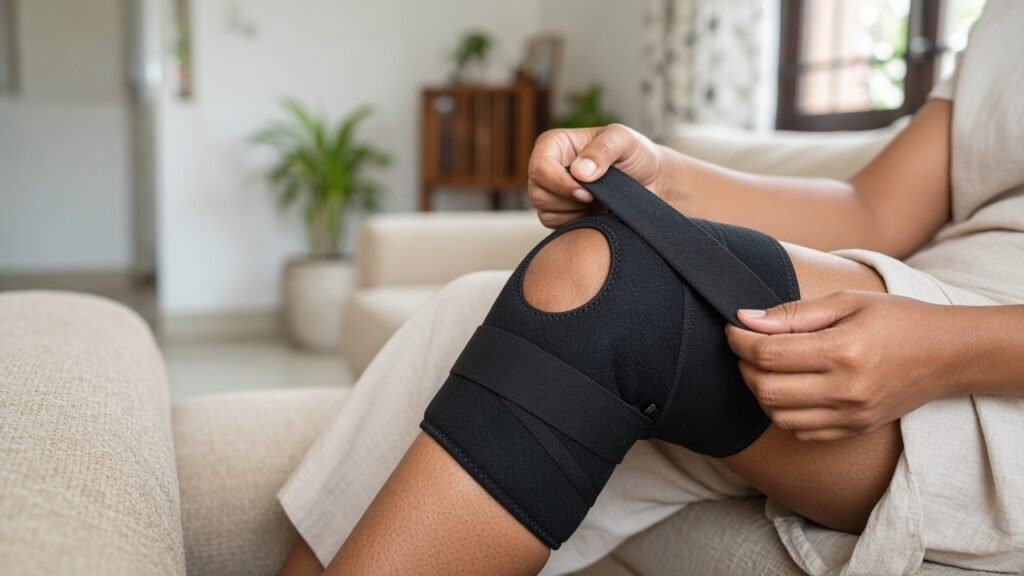
That is exactly why I added the TYNOR Knee Wrap (Neo), adjustable to the PhysioGain Healing Store. It opens up fully and wraps around the knee, so there is no pulling it on over the foot. Below I explain who it suits, who should skip it, and how to wear it properly.
What the TYNOR Knee Wrap (Neo) is
This is a soft, wrap-around knee support. Going by the product listing on Amazon.in, it has:
- A wrap-around design with hook-and-loop (velcro) closure, so you can set how firm it feels
- Four-way stretch fabric for compression
- An opening at the front for the kneecap, with silicone padding around it
- A thicker fabric that holds body heat and keeps the knee warm
- Universal size, washable and light
It is not a hinged brace and has no rigid side supports. It is a compression support that is easier to put on and adjust than a pull-on sleeve.
Wrap-around or pull-on: which one should you pick?
I have already written about the Tynor Knee Cap Air, which is a light, breathable pull-on sleeve. Both give gentle compression, but a pull-on sleeve is thinner and better for hot days and wearing under trousers.
A wrap-around support like the Knee Wrap (Neo) makes more sense if:
- You find it hard to bend down and pull a sleeve over your foot
- You have stiff hands, a stiff back or limited hip bending
- You want to loosen or tighten it during the day, for example after sitting for long
- You like the feeling of warmth around the knee, especially in winter
How a knee support like this can help
Cleveland Clinic explains that knee braces and sleeves may ease symptoms like pain and stiffness and can help people feel safer and more confident when they move. They also note that a sleeve type support gives light compression and is the most common knee support people wear (Cleveland Clinic).
For knee arthritis in particular, Cleveland Clinic says a compression sleeve can reduce swelling and warm the joint, and that for mild arthritis a sleeve type brace may be enough. A specialist they quote even suggests choosing one with an opening at the kneecap, which is the design this wrap uses (Cleveland Clinic).
Who this wrap is a good fit for
- Older adults with mild, achy knee osteoarthritis who want some comfort while walking or doing housework
- People who feel their knee is stiff and cold in the morning or in winter and like gentle warmth
- Those who struggle with pull-on knee caps because of back, hip or hand stiffness
- Gym-goers and recreational players who want light compression and a bit of confidence while they get back into training after a minor niggle
Who should not rely on it
Please skip it, or check with a physio or doctor first, if any of these apply to you:
- A fresh injury with a pop, quick swelling or the knee giving way. Ligament or meniscus injuries usually need proper assessment and often a more structured brace.
- A kneecap that has slipped out of place or feels unstable. A soft wrap is not designed to control that.
- A hot, red, very swollen knee, or a fever. The NHS lists these as reasons to get urgent advice, since they can be a sign of infection (NHS).
- Poor circulation, diabetes with reduced feeling in the legs, varicose veins that hurt, or fragile skin. Compression needs more care here.
- Calf pain with warmth and swelling. See a doctor quickly. That is not a job for a knee support.
How to put it on properly
A wrap is only as good as its fit. Here is the method I teach my patients.
1. Sit down with the knee slightly bent
Sit on a chair with your foot flat on the floor and the knee bent a little.
2. Line up the opening with your kneecap
Open the wrap fully, place it behind the knee, and bring the two sides to the front. The hole should sit over the kneecap, with the padding around it. The kneecap should not be squeezed under the fabric.
3. Fasten firm, but not tight
Close the velcro so it feels snug and secure. Cleveland Clinic says a brace should be snug without being too tight, and it should not hurt or feel like it is cutting off circulation (Cleveland Clinic). You should be able to slide a finger under the edge.
4. Do a quick test
Stand up, walk a few steps and do two or three slow sit-to-stands. The wrap should stay in place and the knee should feel the same or more comfortable. If it slides down, re-place it a little higher and refasten.
5. Check your skin and your foot
Tingling, numbness, coldness or colour change in the foot, or a painful mark on the skin, means it is too tight. Loosen it straight away. Skin irritation and pressure marks are possible with any support, so check your skin when you take it off, especially in the first week.
How long should you wear it?
Wear it during the activities that bother you, like a long walk, kitchen work or stairs, and take it off when you rest. Wearing it all day without doing any exercise is the habit I want you to avoid.
What to pair it with
A support works best as part of a plan. For knee osteoarthritis, the NHS describes exercise as one of the most important treatments, whatever your age or fitness, with a mix of muscle strengthening and general fitness work. They also mention that keeping a healthy weight helps, and that hot or cold packs, the right footwear, and leg braces and supports can make daily life easier (NHS).
If your knee started aching before anyone mentioned arthritis, my post on why the knee hurts before arthritis is diagnosed explains what may be going on.
Quick buying checklist
- You want gentle compression and warmth, not rigid support
- Pulling a knee cap over your foot is difficult for you, or you want adjustable fit
- You do not have a fresh injury, an unstable kneecap or circulation problems
- You have checked the current listing for size range, material and wash care
- You plan to use it alongside exercise, not instead of it
If this matches what you need, you can check the TYNOR Knee Wrap (Neo) on Amazon.in.
When to see a physio instead
The NHS advises seeing a GP if knee pain does not improve within a few weeks, and getting urgent advice if the knee is very painful, badly swollen, changes shape, locks, gives way, or you cannot put weight on it (NHS). I would add: if you find you cannot walk or do stairs without the support, it is time for a proper assessment rather than a tighter wrap.
You can read more on our knee pain condition page, or book an assessment with me so we can find the cause and build a plan for your knee.
FAQ
Is the TYNOR Knee Wrap (Neo) good for knee arthritis?
It can be a comfortable option for mild, achy arthritic knees, mainly for warmth, gentle compression and confidence. It will not change the arthritis itself, so keep up your exercises.
Will it help after a ligament injury or surgery?
Not on its own. After a ligament injury or surgery you usually need a specific brace and a guided rehab plan. Ask your surgeon or physio before using any soft wrap.
My verdict
The TYNOR Knee Wrap (Neo) is a sensible, easy-to-wear option if you want gentle compression and warmth for an achy knee, and especially if pulling a knee cap over your foot is a struggle. The open kneecap design, adjustable closure and warm fabric make it comfortable for daily activity, mild arthritis and getting back into light exercise. It is not the right choice for fresh injuries, an unstable kneecap, circulation problems or very hot, sweaty days.
If it sounds right for you, see the TYNOR Knee Wrap (Neo) on Amazon.in. And if you are not sure what is behind your knee pain, start with an assessment first.
Dr. Lakshay Sharma PT, BPT (Delhi University), MPT in Sports and Musculoskeletal Physiotherapy, sports rehab certification from CSPR London.