
Sciatica
Learn what sciatica is, why it causes pain down the leg, and how physiotherapy can help you recover safely and return to everyday activities.
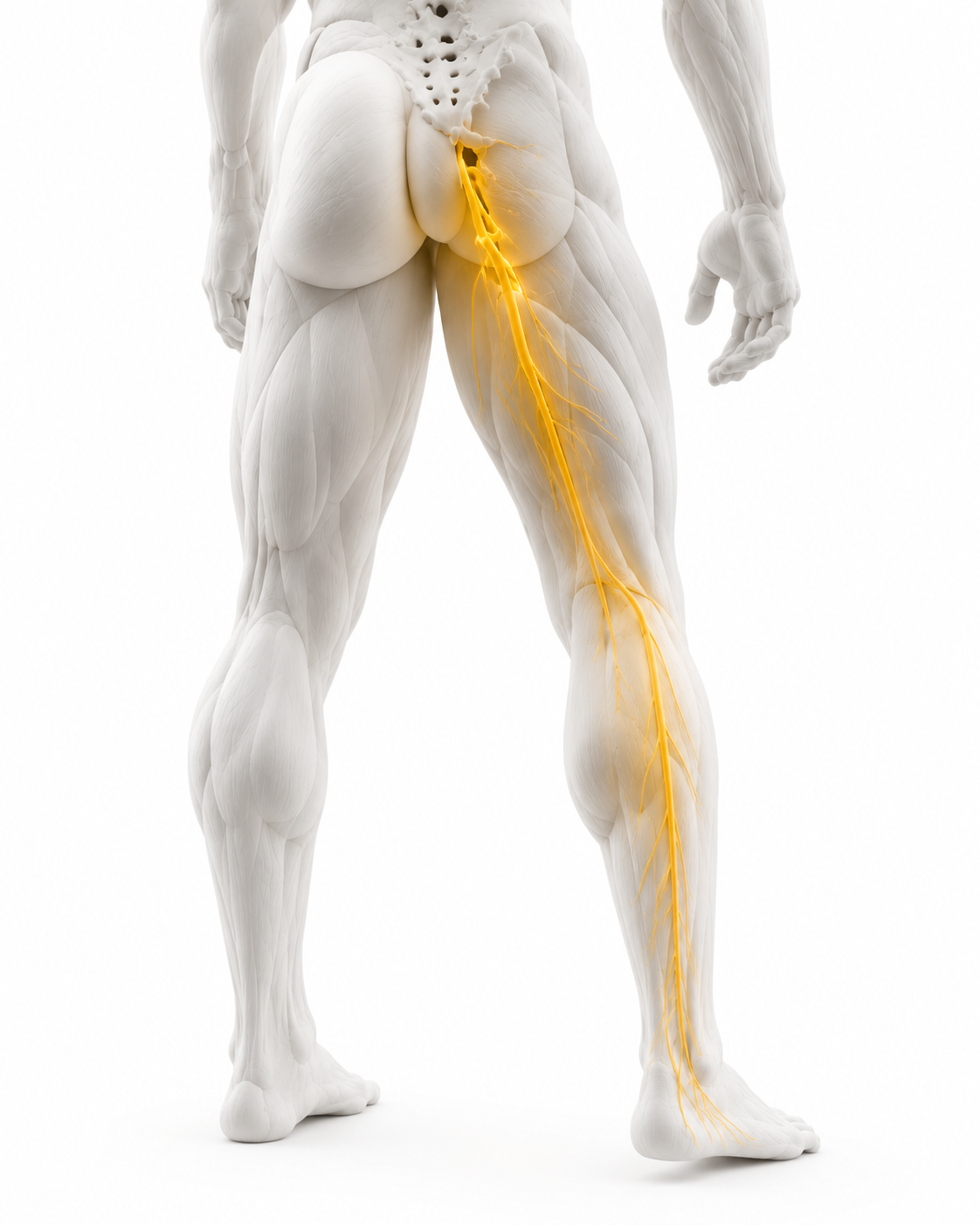
Sciatica occurs when one or more of the nerve roots that form the sciatic nerve become irritated or compressed. It commonly causes pain that travels from the lower back into the buttock and down the leg.
QUICK OVERVIEW
Sciatica at a Glance
COMMON SIGNS & SYMPTOMS
Is This What You're Feeling?
Pain That Travels Down the Leg
Pain usually starts in the lower back or buttock and travels below the knee into the leg.
Sharp or Shooting Pain
Many people describe the pain as sharp, burning, electric, or shooting.
Tingling or Pins and Needles
Abnormal sensations may occur in the leg or foot depending on the affected nerve root.
Numbness
Reduced sensation may develop in specific areas of the leg or foot.
Muscle Weakness
Some people notice weakness when lifting the foot, standing on the toes, or climbing stairs.
Pain When Sitting
Symptoms may worsen during prolonged sitting, driving, or bending forward.
Pain During Coughing or Sneezing
Activities that increase pressure within the spine may temporarily increase symptoms.
Difficulty Walking
Severe leg pain or weakness may affect walking tolerance.
COMMON CAUSES
Why Does It Happen?
Lumbar Disc Herniation
The most common cause of sciatica in younger and middle-aged adults. Disc material may irritate or compress a lumbar nerve root.
Lumbar Spinal Stenosis
Narrowing of the spinal canal or nerve openings may compress nerve roots, particularly in older adults.
Degenerative Changes
Age-related changes in the spine may reduce the space available for nerve roots.
Spondylolisthesis
One vertebra slips forward over another, potentially narrowing the space around a nerve root.
Trauma
Falls or significant injuries can occasionally damage structures around the lumbar spine and affect nerve roots.
Rare Causes
Tumors, infections, inflammatory disorders, or fractures are uncommon but require urgent medical evaluation.
RISK FACTORS
Who Is Most at Risk?
Office Workers
Prolonged sitting may aggravate symptoms in some individuals.
Manual Workers
Frequent lifting, bending, twisting, and heavy physical work.
Drivers
Long periods of sitting and whole-body vibration may contribute to symptoms.
Older Adults
Higher likelihood of lumbar spinal stenosis and degenerative spinal changes.
Smokers
Smoking has been associated with poorer spinal disc health and delayed tissue healing.
Individuals with Previous Episodes
Previous sciatica increases the risk of recurrence.
DIAGNOSIS
How Is It Diagnosed?
Clinical Assessment
Medical History
- Where the pain travels
- When symptoms started
- Leg numbness or tingling
- Muscle weakness
- Aggravating activities
- Bladder or bowel symptoms
- Previous episodes
- Occupation and activity level
Physical Examination
- Walking pattern
- Lumbar movement
- Neurological examination
- Muscle strength
- Reflexes
- Sensation testing
Special Tests & Imaging
Special Tests
- Straight Leg Raise (SLR)
- Crossed Straight Leg Raise
- Slump Test
- Neurological examination
- Functional assessment
No single test confirms sciatica. Diagnosis is based on the combination of symptoms, physical examination, and clinical reasoning.
Imaging
Routine MRI is not necessary for most people with uncomplicated sciatica. MRI may be recommended when severe or progressive neurological deficits are present, symptoms persist despite appropriate conservative treatment, surgery is being considered, or serious pathology is suspected.
SEEKING HELP
When Should You Get Help?
Self-Management
Usually appropriate if:
- Mild leg pain
- Symptoms are improving
- Able to walk normally
- No significant weakness
Book a Physiotherapy Assessment
Recommended if:
- Pain radiates below the knee
- Symptoms last longer than one to two weeks
- Walking becomes difficult
- Recurrent episodes
- Numbness or tingling persists
Seek Immediate Medical Attention
Seek urgent medical care if you experience:
- Loss of bladder or bowel control
- Numbness around the saddle or groin area
- Rapidly progressing leg weakness
- Inability to lift the foot (new foot drop)
- Severe pain following major trauma
- Fever with severe back pain
- Unexplained weight loss with persistent symptoms
TREATMENT
Treatment Options
Education
Understanding sciatica, remaining active within comfortable limits, and avoiding prolonged bed rest are important parts of recovery.
Exercise Therapy
Individualized exercises may help improve movement, reduce pain, and restore function.
Manual Therapy
Manual therapy may help some individuals as part of a comprehensive treatment programme that includes exercise and education.
Activity Modification
Remaining active while temporarily modifying aggravating activities is generally recommended.
Medication
Pain-relieving medication may be appropriate under medical supervision for short-term symptom management.
Epidural Steroid Injection
Some people with persistent, severe nerve root pain may benefit from an epidural steroid injection after specialist evaluation.
Surgery
Surgery may be considered when there is significant or progressive neurological deficit, cauda equina syndrome, or persistent disabling symptoms.
PHYSIOTHERAPY
How Physiotherapy Helps
Physiotherapy aims to reduce nerve-related pain, improve movement, restore strength, and help you safely return to daily activities.
Treatment may include:
- Individualized exercise programmes
- Nerve mobility exercises when appropriate
- Lumbar mobility exercises
- Core strengthening
- Functional movement retraining
- Walking programmes
- Education on symptom management
- Return-to-work guidance
- Strategies to reduce recurrence
RECOVERY JOURNEY
Recovery Timeline
EXERCISE LIBRARY
Recommended Exercises
Walking Programme
EasyTarget: General mobility and function
Duration: Short, frequent walks as tolerated
Prone Press-Up (for selected individuals)
EasyTarget: Lumbar extension mobility
Repetitions: 10 repetitions
Precaution: Appropriate only for individuals whose symptoms improve with extension.
Pelvic Tilt
EasyTarget: Core activation and lumbar mobility
Repetitions: 10–15 × 2 sets
Sciatic Nerve Slider
ModerateTarget: Neural mobility
Repetitions: 10 gentle repetitions
Precaution: Nerve-gliding exercises should be prescribed after assessment.
Bird Dog
ModerateTarget: Core stability
Repetitions: 8–12 each side
Bridge Exercise
ModerateTarget: Gluteal muscles and posterior chain
Repetitions: 10–15 × 2 sets
LONG-TERM HEALTH
Prevention Tips
Stay Physically Active
Regular physical activity helps maintain spinal health and overall function.
Lift Safely
Use appropriate lifting techniques and avoid sudden twisting under heavy loads.
Build Core and Hip Strength
Strong trunk and hip muscles support spinal function during daily activities.
Avoid Prolonged Sitting
Take regular movement breaks every 30–60 minutes if your work involves sitting.
Stop Smoking
Smoking is associated with poorer spinal disc health and slower healing.
Progress Exercise Gradually
Increase activity and exercise loads progressively rather than making sudden changes.
EXPLORE MORE
Related Conditions
Lumbar Disc Herniation
Low Back Pain
Lumbar Spinal Stenosis
Piriformis Syndrome
Spondylolisthesis
Degenerative Disc Disease
Sacroiliac Joint Dysfunction
Cauda Equina Syndrome (Medical Emergency)
Lumbar Radiculopathy
Facet Joint Pain
Ready to Get Back on Your Feet?
If pain is travelling from your lower back into your leg, a physiotherapy assessment can help determine whether sciatica or another condition is responsible. We'll identify the likely source of your symptoms and develop a personalised rehabilitation plan to reduce pain, improve movement, and help you return to daily life with confidence.
Book Your Physiotherapy Assessment TodayEarly intervention often leads to faster and better outcomes.