
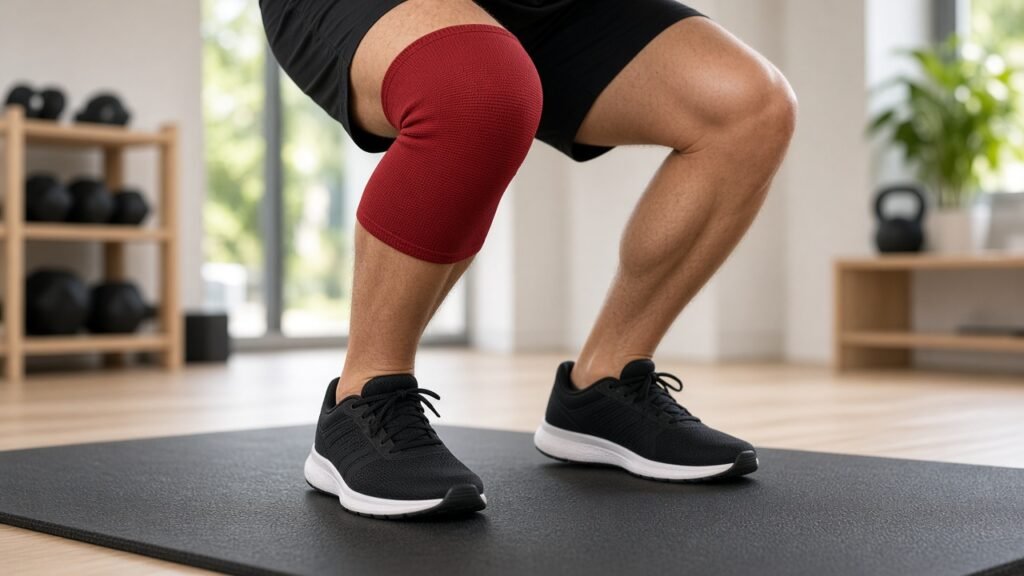
Affiliate disclosure: This post contains affiliate links. If you buy through them, PhysioGain may earn a small commission at no extra cost to you. I only list products I would be comfortable suggesting to my own patients. This guide is general information and not a substitute for a proper assessment.
Many of the young people who come to me with knee niggles are not elderly or arthritic. They are gym-goers, weekend cricketers, badminton players and people who have just started walking 8 to 10 thousand steps a day. Almost all of them ask the same thing: “Should I wear a knee cap while I train?”
My honest answer is: sometimes, yes, as long as you know what it can and cannot do. In this guide I talk about the Boldfit Orthopedic Knee Caps from the PhysioGain Healing Store, who they make sense for, how to wear them during exercise, and the mistakes I see people make with knee sleeves.
What the Boldfit Orthopedic Knee Caps are
These are pull-on compression knee sleeves. Going by the product listing on Amazon.in:
- They are made from a nylon and latex blend, described as anti-slip
- They give even compression around the knee without stopping you from bending it
- They come in four sizes: Small, Medium, Large and Extra Large
- They are washable and meant for sports, gym work, running and daily walking
They are not a hinged brace. There are no metal or plastic side supports, so they will not hold an unstable knee in place. Think of them as a snug, supportive layer, not a cast.
If your main need is a light, breathable sleeve for long hours of daily wear, I have also written about the Tynor Knee Cap Air. The Boldfit sleeves are more of an active-use option, which is why this guide focuses on exercise and sport.
How a knee sleeve can help when you are active
Cleveland Clinic explains that knee braces and sleeves support the knee, and that sleeves are the most common type people wear. They also say clearly that a brace is not a substitute for seeing a healthcare provider, especially for new or worsening pain (Cleveland Clinic).
From a physio point of view, the most interesting effect of a sleeve is on “joint position sense”, which is your brain’s ability to know where your knee is without looking at it. In a small study of 20 healthy, active people, wearing a neoprene knee sleeve improved accuracy on several joint position sense tests (Herrington et al., Research in Sports Medicine, 2005). The Boldfit sleeve uses a different material, and one small study does not prove much, but it fits with what my patients tell me: the knee “feels more connected” with a sleeve on.
In practice, that can mean:
- A bit more confidence during squats, lunges and stairs
- A feeling of warmth and support during the first few minutes of a workout
- Less of that vague, unsure feeling in a knee that has been niggly
What a sleeve does not do: it does not repair cartilage, fix a torn ligament or correct poor movement. Strength and good loading do that.
Who these knee caps suit
- Gym-goers who feel mild, achy knees during squats, lunges or leg press
- Recreational players of badminton, cricket, football or kabaddi who like the feel of support while playing
- People starting a walking or jogging routine who notice mild knee tiredness
- Someone with mild, already-assessed knee pain whose physio is happy for them to use a sleeve during exercise
Who should not rely on them
- Anyone allergic to latex. The listing says the fabric contains latex. Latex allergy can cause itching, redness, hives and swelling, and in some people severe reactions (Leeds Teaching Hospitals NHS Trust). If you have this allergy, choose a latex-free support.
- A knee that gives way or locks. This needs a proper assessment, not a sleeve.
- A fresh injury with a lot of swelling, or a knee that looks deformed after a twist or fall.
- People with poor circulation, diabetic nerve problems or fragile skin should check with their doctor before using any compression.
- Anyone after knee surgery should follow their surgeon’s or physio’s brace plan instead.
The NHS advises getting urgent advice if your knee is very painful, you cannot put weight on it, it is badly swollen or changed in shape, or it locks or gives way (NHS). A sleeve will not help any of these.
How to wear them during exercise
1. Get the size right
This is where most people go wrong. Measure around your knee as the seller’s size chart asks, and pick the size that matches. It should feel snug and even, like a firm hug. If it pinches behind the knee, leaves deep marks, or your foot feels tingly or cold, it is too tight. If it slides down during squats, it is too loose.
2. Put it on properly
Sit down, slide it up over the foot and calf, and centre it over the kneecap. Smooth out any folds, especially at the back of the knee, as a fold there can rub during bending.
3. Wear it for the session, not all day
For gym and sport, I usually suggest putting it on for the workout or match and taking it off afterwards. Give your skin a break and let your muscles do the work for the rest of the day.
4. Pair it with strength work
This is the part that actually changes knees. A simple base I give many active patients includes sit-to-stands from a chair, step-ups on a low step, glute bridges, side-lying leg raises and calf raises. Build up slowly over weeks. If you have pain on stairs, my post on knee pain on stairs explains the common reasons and what helps.
Common mistakes I see with knee sleeves
- Using it to push through sharp pain. A sleeve may make you feel braver, but sharp or worsening pain is a signal to stop and get checked.
- Buying one size up “for comfort”. A loose sleeve just bunches up and gives you nothing.
- Wearing it 24 hours a day. There is no need for most people, and skin can get irritated.
- Skipping strength training. If you need a sleeve for every single workout for months, that is a sign to look at why the knee is unhappy.
- Not washing it. Sweat builds up quickly in a gym sleeve. Wash it as the label says and let it air dry.
If you are young and wondering why your knees are already complaining, you may find why young adults are getting knee pain earlier than ever useful.
A quick buying checklist
- Do I know my knee measurement and the right size from the chart?
- Am I free of any latex allergy?
- Is my knee pain mild and without locking, giving way or major swelling?
- Do I want it mainly for exercise and sport, not for a serious injury?
- Am I ready to do strength exercises alongside it?
If you ticked all five, you can check the Boldfit Orthopedic Knee Caps on Amazon.in and choose your size there.
FAQ
Can I wear Boldfit knee caps while running?
Yes, many runners like the feel of a sleeve. Make sure it does not slip or rub on longer runs, and build your distance gradually. If knee pain keeps coming back with running, get your running load and strength assessed.
Do knee caps weaken the muscles?
A soft sleeve worn during exercise is unlikely to be the problem. Muscles get weaker when we stop loading them. Keep up your strength work and use the sleeve as support, not as a replacement for training.
Should I wear one on both knees?
Only if both knees bother you. There is no benefit in wearing one on a knee that feels fine.
Is a knee sleeve enough for a ligament or meniscus injury?
No. Suspected ligament or meniscus injuries need a proper assessment, and some need a structured brace and rehab plan.
My verdict
The Boldfit Orthopedic Knee Caps are a simple, sensible option for active people with mild knee aches who want a supportive, snug feel during the gym, sport or walking. They are not a medical brace, and they are not for latex allergy, unstable knees or fresh injuries. Used with the right size and alongside proper strengthening, they can make training feel more comfortable and confident.
If that sounds like you, see the Boldfit Orthopedic Knee Caps on Amazon.in.
And if your knee pain is stopping you from training, or you are not sure what is going on, book an assessment with me. I would much rather check your knee properly than have you guess.
Dr. Lakshay Sharma PT, BPT (Delhi University), MPT in Sports and Musculoskeletal Physiotherapy, sports rehab certification from CSPR London.