
Affiliate disclosure: This post contains affiliate links. If you buy through them, PhysioGain may earn a small commission at no extra cost to you. I only list products I would be comfortable suggesting to my own patients. This guide is general information and not a substitute for a proper assessment.
Most people who buy a patella strap make the same small mistake. They wear it in the wrong spot, pull it too tight, and then decide it “does not work”. I see this often in my home visits in Delhi, especially with runners and weekend cricket and badminton players.
So this guide is a little different from a normal product review. I will tell you what the Bodyprox Patella Tendon Knee Strap (2 pack) is, who it suits, and most importantly, how to wear it properly so you actually get the benefit. I will also be honest about when a strap is the wrong answer.
What you get with the Bodyprox Patella Tendon Knee Strap
This is a slim band that wraps around the leg just under the kneecap. Going by the product listing, it has a padded front section, hook-and-loop (velcro) closure, small ventilation holes, and it is one size, adjustable for a knee circumference of roughly 13 to 18 inches (about 33 to 46 cm). It comes as a pack of two straps.
The two-pack is the main reason I added it to the PhysioGain Healing Store. Some people have niggles in both knees. Others like to keep one strap in the kit bag and one at home, or simply have a spare while one is drying after a sweaty session.
Please measure around your knee before ordering. If your leg is bigger or smaller than that range, this one will not fit you well, and a strap that does not sit firmly is not worth using.
How a patella strap is meant to help
The patellar tendon is the thick cord between the bottom of your kneecap and your shin bone. Every time you jump, land, run downhill or come up from a deep squat, this tendon takes a lot of load.
Cleveland Clinic explains that a patella band puts gentle pressure on this tendon, which changes how force passes through it during activities like running and jumping, and that it can give some support for patellar tendinitis (jumper’s knee) or patellofemoral pain (runner’s knee) (Cleveland Clinic).
What does the research say? A randomised controlled trial of 97 athletes with patellar tendinopathy found that a patellar strap reduced pain during a demanding single-leg decline squat compared with wearing nothing, but placebo tape also helped people during and after sport (de Vries et al., 2016, PubMed). In simple words: a strap can take the edge off pain in the short term, but it is a helper, not a treatment on its own.
Who this strap is a good fit for
- Runners and walkers who get a nagging ache right under the kneecap on longer or downhill sessions
- Players of badminton, basketball, volleyball, football or cricket who jump, land and change direction a lot
- Gym-goers who feel that same spot during squats, lunges or step-ups
- People who have already been told by a physio or doctor that the pain is coming from the patellar tendon or the front of the knee, and want something light to wear while they rehab
- Anyone who finds a full knee cap too hot or bulky and wants something minimal
Who should not rely on it
A strap is small, but it is still not for everyone. Please skip it, or talk to a physio first, if you have:
- A kneecap that has slipped out of place (dislocation) or feels like it is shifting. That needs a proper assessment and usually a different kind of support.
- A fresh injury with a twist, a pop, quick swelling, or the knee giving way. Ligament and meniscus injuries are not something a strap can manage.
- Pain that is mostly at the back or inner side of the knee, or a stiff, swollen arthritic knee. A sleeve or a different plan may suit you better.
- Circulation problems, diabetes with reduced feeling in the legs, or skin that breaks easily. Pressure around the leg needs more care in these cases.
- Calf pain, warmth and swelling in the leg. That needs a doctor quickly, not a strap.
How to wear it properly: my step-by-step method
This is the part most people get wrong, so take two minutes to do it right.
1. Find the tendon
Sit on a chair with your knee bent to about 90 degrees. Feel the bottom tip of your kneecap. Just below it you will feel a firm, rope-like band. That is your patellar tendon.
2. Place the pad on the tendon
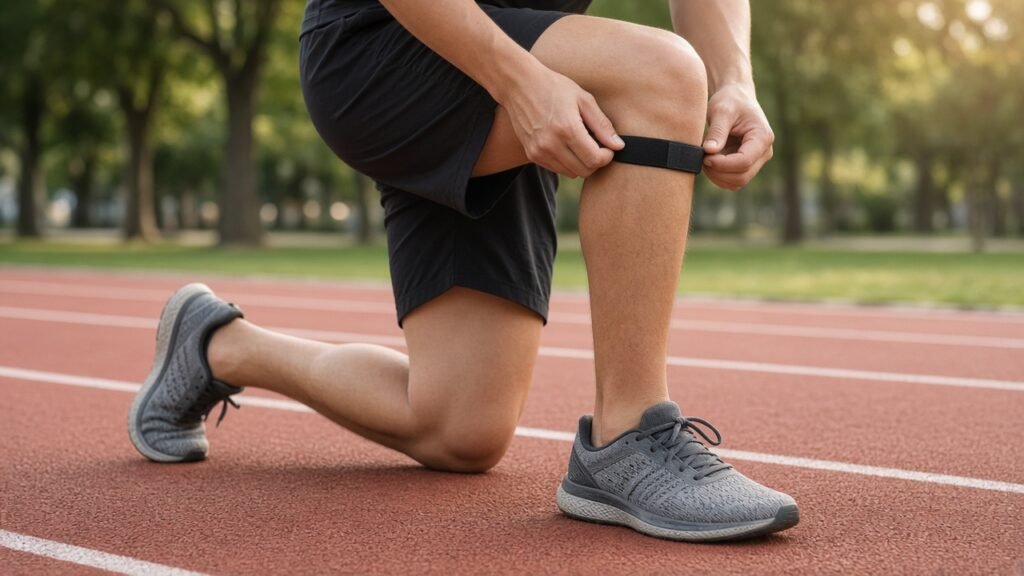
Wrap the strap around the leg so the padded front part sits right on that band, just under the kneecap. Cleveland Clinic makes the same point: the padded centre should sit directly below the kneecap. Not on the kneecap and not halfway down the shin.
3. Tighten to “firm, not fierce”
Close the velcro so you feel gentle pressure on the tendon. You should be able to slide a finger under the strap. If your foot tingles, feels numb, goes pale or the area throbs, it is too tight. Loosen it straight away.
4. Test it before you train
Do five or six slow half squats or a few steps up and down a stair. The strap should stay in place and the movement should feel the same or easier. If it slides, re-place it. If pain clearly increases, take it off and get the knee checked.
5. Wear it for activity, then take it off
I tell my patients to wear the strap for the run, the match or the gym session, and remove it afterwards. Sleeping in it or wearing it all day is not needed. Check your skin when you take it off, especially in the first week.
One knee or both?
Only strap the knee that hurts. Cleveland Clinic also notes that one strap on the troublesome knee is fine and you do not need to brace both. The second strap in the pack is useful if both knees bother you, or just as a spare.
Common mistakes I see
- Wearing it on the kneecap. It needs to be below the kneecap, on the tendon.
- Pulling it like a tourniquet. More pressure does not mean more relief.
- Using it to push through sharp pain. If the strap is the only reason you can play, the tendon needs a smarter loading plan.
- Skipping strength work. The strap may calm things down for a session. Strong quads, hips and calves are what help the tendon cope over time.
- Never washing it. Sweat breaks down velcro and irritates skin. Follow the care instructions on the listing.
What to pair it with
Cleveland Clinic lists physical therapy, with flexibility and strengthening work for the muscles around the knee, as one of the main treatments for patellar tendinitis, along with relative rest from the activity that caused it (Cleveland Clinic). In practice, I usually combine a strap with:
- A short break or cut-back in jumping and running volume, then a gradual return
- Slow, controlled strengthening for the thigh, hip and calf, adjusted to your pain level
- A look at footwear, training surface and how quickly the training load went up
If stairs are also painful, you may find my guide on knee pain on stairs useful. And if you want a single strap instead of a pair, I have also written about the Tynor Patellar Support, which does a similar job.
Quick buying checklist
- Your pain is right under the kneecap, not all over the knee
- You have measured your knee and it falls within the stated size range
- You do not have kneecap instability, a fresh twisting injury or circulation problems
- You are ready to pair it with exercise, not use it alone
- You have checked the current listing for size, material and care details
If that sounds like you, you can check the Bodyprox Patella Tendon Knee Strap on Amazon.in.
When to see a physio instead
Please get the knee assessed if the pain has lasted more than a few weeks, is getting worse, wakes you at night, comes with swelling or locking, or makes normal walking and stairs hard. Front-of-knee pain has several possible causes, and the right plan depends on which one you have. You can explore our knee pain condition page, or book an assessment with me for a personal plan.
FAQ
Can I wear the Bodyprox strap while running?
Yes, that is what it is designed for. Place it correctly before you start, and re-check it after the first few minutes, since straps can shift a little when you sweat.
How long should I wear a patella strap each day?
Only during the activity that triggers your pain. Take it off afterwards and let the skin breathe.
Will a patella strap fix jumper’s knee?
No. It may reduce pain during activity, but the tendon gets better with load management and the right exercises. Think of the strap as support while you do that work.
Is it the same as a knee cap or sleeve?
No. A sleeve covers the whole joint and gives general compression and warmth. A strap puts focused pressure on one small area, the patellar tendon.
Can older adults with knee arthritis use it?
Usually a strap is not the first choice for arthritic knee pain. A sleeve, exercise and a proper assessment tend to make more sense. Check with your physio first.
My verdict
The Bodyprox Patella Tendon Knee Strap is a simple, light option for pain just below the kneecap during running, jumping and gym work, and the two-pack makes it practical if both knees act up or you want a spare. It works best when it is placed right on the tendon, kept snug but not tight, and paired with a proper strengthening plan. It is not for unstable kneecaps, fresh injuries or general knee arthritis.
If your symptoms match, see the Bodyprox 2 pack on Amazon.in. If you are not sure what is causing your knee pain, start with an assessment first.
Dr. Lakshay Sharma PT, BPT (Delhi University), MPT in Sports and Musculoskeletal Physiotherapy, sports rehab certification from CSPR London.