
PCL Injury
Injured your knee after a fall, sports collision, or dashboard injury? Learn what a PCL injury is, how it's diagnosed, and how physiotherapy helps restore knee stability and function.
The posterior cruciate ligament (PCL) is one of the main stabilising ligaments inside the knee. It prevents the shin bone from moving too far backward. Many isolated PCL injuries recover well with structured physiotherapy.
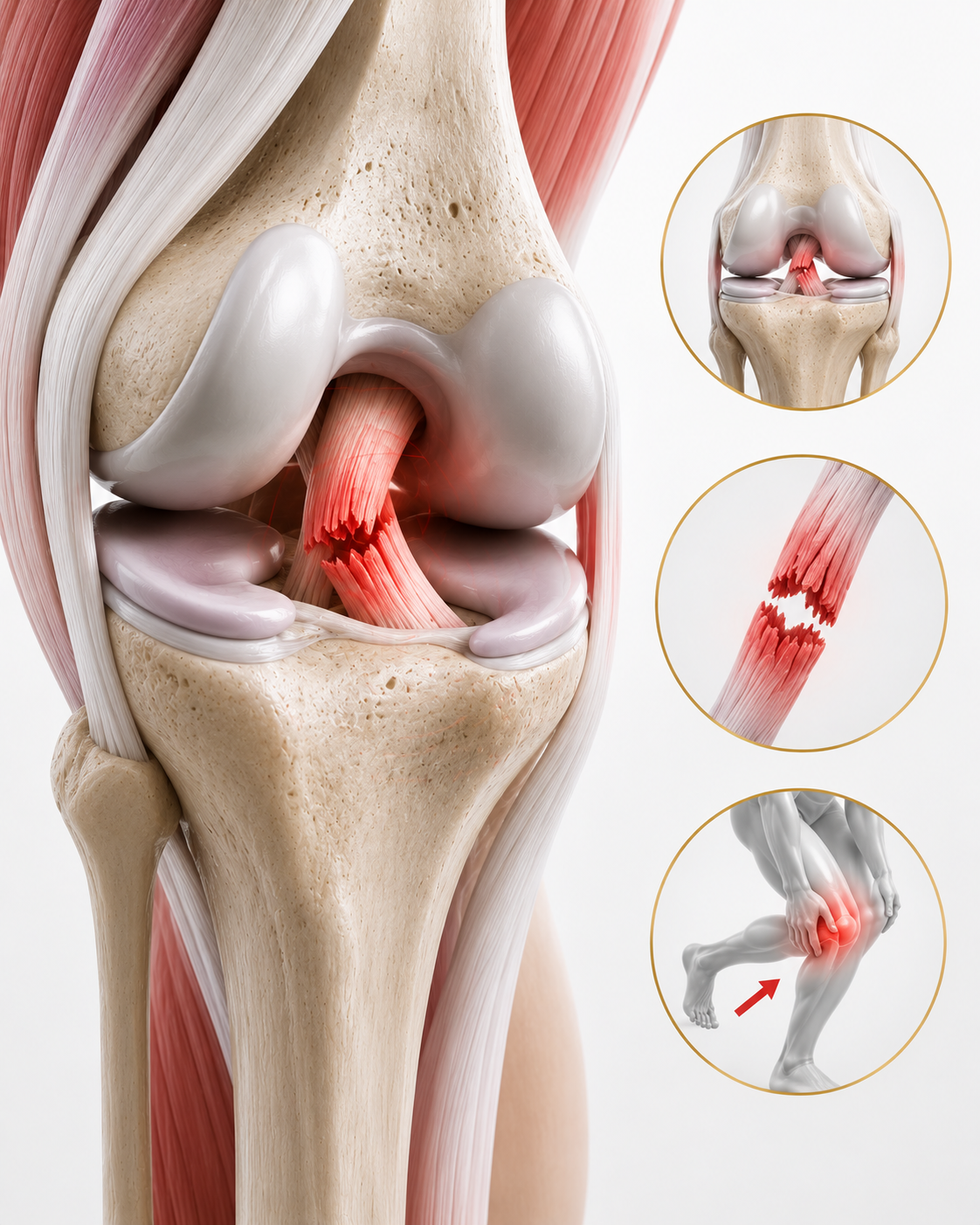
QUICK OVERVIEW
PCL Injury at a Glance
COMMON SIGNS & SYMPTOMS
Is This What You're Feeling?
Knee Pain
Pain is often felt deep within the knee, particularly after injury.
Swelling
Swelling usually develops within the first few hours after injury.
Feeling of Instability
Some people describe the knee as feeling loose or unstable, especially on slopes or stairs.
Difficulty Walking
Walking may feel uncomfortable during the early stages.
Pain Going Down Stairs
Descending stairs often places greater stress on the PCL.
Reduced Knee Movement
Difficulty fully bending or straightening the knee.
Weakness
Quadriceps weakness commonly develops after injury.
Difficulty Returning to Sport
Running, jumping, and pivoting activities may remain challenging until rehabilitation is complete.
COMMON CAUSES
Why Does It Happen?
Dashboard Injury
The classic mechanism involves the front of the bent knee striking a car dashboard during a collision.
Fall onto a Bent Knee
Landing directly on the front of a flexed knee can force the tibia backwards.
Sports Collision
Contact sports such as rugby, football, and hockey increase the risk.
Hyperflexion Injury
Forceful bending of the knee beyond its normal range can injure the PCL.
Hyperextension Injury
Excessive straightening of the knee may injure multiple ligaments, including the PCL.
Combined Ligament Injury
PCL injuries may occur alongside ACL, MCL, LCL, meniscal, or posterolateral corner injuries.
RISK FACTORS
Who Is Most at Risk?
Contact Sport Athletes
Football, rugby, hockey, and martial arts.
Motor Vehicle Occupants
Dashboard injuries remain a classic mechanism.
Skiers
Falls and twisting injuries increase risk.
Individuals with Previous Knee Injuries
History of ligament injury may increase future risk.
Active Adults
Participation in high-impact activities.
Military Personnel
Physically demanding occupations may increase exposure to knee trauma.
DIAGNOSIS
How Is It Diagnosed?
Clinical Assessment
Medical History
- Mechanism of injury
- Swelling
- Instability
- Ability to walk
- Sporting demands
- Previous knee injuries
- Functional limitations
Physical Examination
- Knee swelling
- Range of motion
- Walking pattern
- Muscle strength
- Functional movements
Special Tests & Imaging
Special Tests
- Posterior Drawer Test (most commonly used)
- Posterior Sag Sign (Godfrey Test)
- Quadriceps Active Test
- Dial Test (to assess posterolateral corner injury)
- Ligament assessment for ACL, MCL, and LCL
Diagnosis is based on your history, examination findings, and imaging when appropriate.
Imaging
X-rays may be used to exclude fractures. MRI is the preferred imaging investigation for confirming PCL injury, assessing menisci, identifying cartilage injuries, and detecting associated ligament damage.
SEEKING HELP
When Should You Get Help?
Self-Management
Appropriate only after medical assessment if:
- Mild symptoms
- Improving function
- Stable knee
- No significant swelling
Book a Physiotherapy Assessment
Recommended if:
- Persistent pain
- Knee instability
- Difficulty walking
- Difficulty returning to sport
- Ongoing weakness
- Swelling continues
Seek Immediate Medical Attention
Seek urgent medical assessment if you experience:
- Obvious knee deformity
- Inability to bear weight
- Loss of circulation below the knee
- Significant numbness
- Severe trauma
- Suspected fracture or knee dislocation
TREATMENT OPTIONS
Treatment Options
Education
Understanding the severity of the injury and expected recovery helps guide rehabilitation.
Bracing
Some isolated PCL injuries may be managed with a specialised PCL brace during the early stages to reduce posterior sag and support healing.
Exercise Therapy
Progressive strengthening and neuromuscular rehabilitation form the cornerstone of treatment.
Activity Modification
High-impact and pivoting activities are temporarily reduced while healing progresses.
Medication
Pain-relieving medication may be appropriate under medical supervision during the early recovery period.
Surgery
PCL reconstruction may be considered for Grade III tears with functional instability, combined ligament injuries, persistent instability despite rehabilitation, or high-demand athletes in selected situations.
PHYSIOTHERAPY
How Physiotherapy Helps
Physiotherapy focuses on restoring knee stability, strength, movement, and confidence.
Treatment may include:
- Pain and swelling management
- Range-of-motion exercises
- Progressive quadriceps strengthening
- Balance training
- Neuromuscular rehabilitation
- Walking retraining
- Running progression
- Sport-specific rehabilitation
- Return-to-sport testing
- Long-term injury prevention
Clinical note: Early rehabilitation often emphasises quadriceps strengthening while initially limiting exercises that create excessive posterior translation of the tibia, depending on the injury grade and healing stage.
RECOVERY JOURNEY
Recovery Timeline
EXERCISE LIBRARY
Recommended Exercises
Quadriceps Sets
EasyTarget: Quadriceps activation
Repetitions: 10–15 holds
Straight Leg Raise
EasyTarget: Quadriceps
Repetitions: 10–15 × 2–3 sets
Mini Squats
ModerateTarget: Functional lower-limb strength
Repetitions: 10–15 × 3 sets
Step-Ups
ModerateTarget: Functional knee control
Repetitions: 10 each leg
Single-Leg Balance
ModerateTarget: Stability and proprioception
Hold: 30 seconds × 3 repetitions
Stationary Cycling
ModerateTarget: Knee mobility and endurance
Duration: 10–20 minutes
LONG-TERM HEALTH
Prevention Tips
Strengthen Your Quadriceps
Strong quadriceps support knee stability and function.
Improve Landing Mechanics
Practice safe jumping and landing techniques.
Train Balance and Proprioception
Neuromuscular training helps reduce knee injury risk.
Warm Up Properly
Complete a structured warm-up before training and competition.
Progress Training Gradually
Avoid sudden increases in intensity or training volume.
Complete Your Rehabilitation
Returning to sport before meeting objective criteria increases the risk of reinjury.
EXPLORE MORE
Related Conditions
ACL Injury Rehabilitation
Meniscus Injury
MCL Injury
LCL Injury
Knee Pain
Patellofemoral Pain Syndrome
Knee Osteoarthritis
Cartilage Injury
Multi-Ligament Knee Injury
Post-Surgical Rehabilitation
Regain Knee Stability and Confidence
Whether you've sustained an isolated PCL injury or are recovering after PCL reconstruction, early assessment and structured rehabilitation are key to achieving the best outcome. A personalised physiotherapy programme can help reduce pain, rebuild strength, restore stability, and safely guide your return to work, sport, and everyday activities.
Book Your Knee Assessment TodayMost isolated PCL injuries recover well with structured physiotherapy and progressive rehabilitation.