
Affiliate disclosure: This post contains affiliate links. If you buy through them, PhysioGain may earn a small commission at no extra cost to you. I only list products I would be comfortable suggesting to my own patients, and this guide is not a substitute for a proper assessment.
One of the most common things I hear from runners, badminton players and gym-goers is this: “Sir, it hurts right here, just under the kneecap.” They point to one small spot, the thick band that connects the kneecap to the shin bone. That band is the patellar tendon, and when it gets irritated it can make jumping, running, squatting and even stairs feel unpleasant.
A simple patellar strap, like the Tynor Patellar Support that I have listed in the PhysioGain Healing Store, is one of the tools people ask me about. In this guide I will tell you honestly what a strap like this can and cannot do, who it suits, who should skip it, and how to use it the right way.
What is the Tynor Patellar Support?
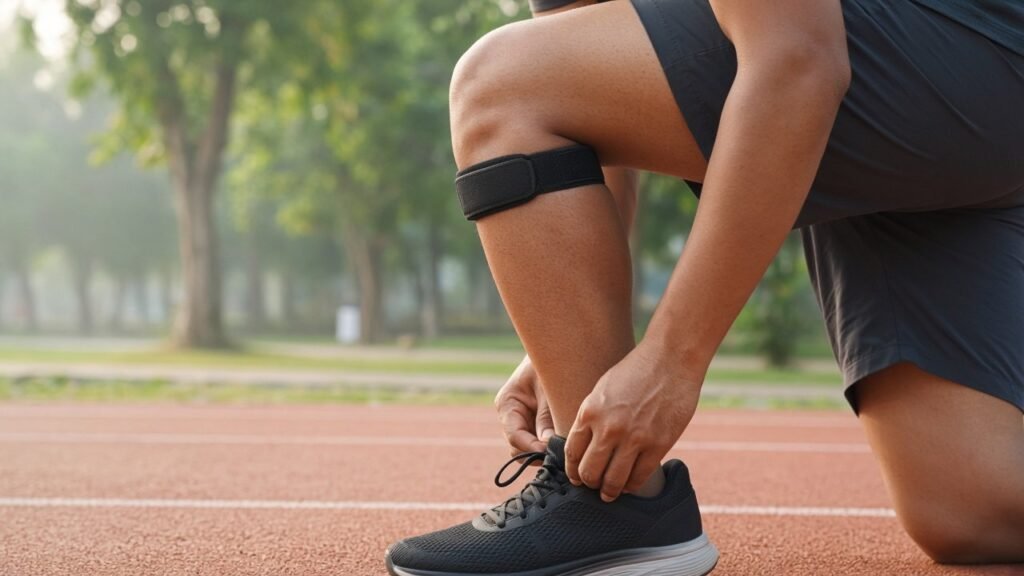
It is a narrow strap that you wear around the leg, just below the kneecap, so that it sits over the patellar tendon. It is not a full knee cap or sleeve. It does not cover the whole joint. It is made to put light, focused pressure on one specific area. The listing in our store is the universal size, which is meant to be adjusted to fit, so always check the size and fit details on the product page before you order.
Because it is small, most people can wear it under track pants or with shorts while they play, run or train.
Who usually gets pain below the kneecap?
Pain in the patellar tendon is often called jumper’s knee or patellar tendinitis. Mayo Clinic describes it as an injury to the tendon that joins the kneecap to the shinbone, most common in sports with a lot of jumping such as basketball and volleyball, though people who do not play jumping sports can get it too (Mayo Clinic).
In my practice I see it in:
- Runners who suddenly increased their weekly distance or added hill work
- Badminton, basketball, volleyball and cricket players who jump and land a lot
- Gym-goers who jumped into heavy squats, lunges or box jumps too quickly
- Weekend players who are active only once or twice a week but go all out
The typical story is pain at the start of activity that may settle as you warm up, then returns after the session or the next morning. Over time it can start to bother you on stairs or when getting up from a chair. If you want to understand this area better, read my detailed post on why your knee hurts below the kneecap.
How does a patellar strap help?
The idea is simple. The strap presses gently on the tendon and changes how load passes through it. Many people feel less pain while they move with it on. Mayo Clinic lists strapping or taping as one of the physical therapy options that can take pressure off the patellar tendon and may help relieve pain (Mayo Clinic).
What does the research say? A randomised controlled trial in 97 athletes with patellar tendinopathy found that a patellar strap reduced pain during a single-leg decline squat compared with wearing nothing. But the researchers also found that placebo tape gave a similar effect, so part of the relief may come from simply having something on the knee (de Vries et al., 2016, PubMed). Another study found that people with patellar tendinopathy reported less pain on single-leg landing with a strap on (PubMed).
So my honest summary is this: a strap can make training more comfortable in the short term. It does not heal the tendon. The tendon gets better with the right amount of load, given in the right way, over weeks.
Who the Tynor Patellar Support is good for
- Active people with pain in the tendon just below the kneecap that comes on with running, jumping or squatting
- Players who want to keep training at a sensible level while they work on a rehab plan
- People who have already been told by a physio or doctor that the problem is in the patellar tendon
- Anyone who finds a full knee sleeve too hot or bulky and wants something small
Who should not rely on it
Please do not use a strap to cover up these situations. Get the knee checked first if you have:
- A recent fall or twist with swelling, or a knee that locks, gives way or feels unstable
- A kneecap that has slipped out of place. A patellar strap is not a fix for patellar dislocation
- Redness, warmth and swelling around the knee, or fever
- Pain that is getting worse week by week, or pain at night and at rest
- Pain mainly around or behind the kneecap rather than on the tendon below it. That can be a different problem that needs a different plan
- Numbness, tingling or a change in skin colour below the strap
- Diabetes with reduced sensation in the legs, or poor circulation. Check with your doctor before using any tight strap
Children and teenagers with pain on the bony bump below the knee also need a proper assessment, because the cause and the plan can be different in a growing knee.
How to wear it the right way
- Find the spot. Sit with your knee bent. Feel the soft, thick band between the bottom of the kneecap and the bump on your shin. The strap goes on this band, just below the kneecap.
- Snug, not tight. You should be able to slide a finger under it. If your foot tingles, your skin goes pale or the area throbs, it is too tight.
- Wear it for activity. Put it on for running, sport or a training session, and take it off afterwards. There is no need to sleep in it or wear it all day.
- Check your skin. Look for redness or rubbing after each use, especially in the first week.
- Keep it clean. Follow the washing instructions on the pack, as sweat can irritate the skin.
What to pair it with
A strap on its own is like an umbrella. It is useful in the rain, but it does not stop the rain. These are the things that actually help the tendon:
- Load management. Reduce the jumping, sprinting and deep squats that flare it up, for a while. You do not always need full rest. Mayo Clinic notes that working through the pain can cause more damage, and suggests switching to a lower impact activity for a time.
- Progressive strengthening. Exercises that increase load on the tendon little by little are the backbone of rehab. Mayo Clinic also points out that weak thigh muscles put strain on the patellar tendon.
- Hip and calf strength. How you land matters. Weak hips and calves often push more load into the front of the knee.
- Sensible return to sport. Build jumping and running back up step by step, not in one go.
The exact exercises and dosage depend on how irritable your tendon is, so this is where a physio really helps. You can also read how patellar compression affects the knee to understand why pain at the front of the knee behaves the way it does.
Common mistakes I see
- Wearing it so tight that the leg below it feels numb
- Placing it on the kneecap itself instead of the tendon below
- Using it as a reason to keep doing the exact same training that caused the pain
- Wearing it for months without doing any strengthening
- Ignoring swelling or giving way because “the strap makes it feel okay”
Quick buying checklist
- Your pain is in the tendon below the kneecap, not all around the joint
- You have no red flags from the list above
- You have checked the size and fit details on the listing
- You are ready to pair it with a strengthening plan
If you tick all four, the Tynor Patellar Support on Amazon.in is a simple tool to try during training.
FAQ
Can I wear a patellar strap all day?
There is usually no need. Most people get the benefit by wearing it during sport or exercise and taking it off afterwards.
Will it cure my jumper’s knee?
No. It may make activity more comfortable, but the tendon gets better with gradual strengthening and sensible load. Think of the strap as support, not treatment.
Is it the same as a knee cap?
No. A knee cap or sleeve covers the whole joint and gives general compression and warmth. A patellar strap is narrow and targets the tendon just below the kneecap. If your pain is more general, my guide to the Tynor Knee Cap Air may be more useful.
When should I see a physio?
If the pain has lasted more than a few weeks, keeps coming back, or stops you from training or climbing stairs comfortably, get it assessed. Also see someone quickly if you have swelling, locking or giving way.
My verdict
For an active person with pain in the patellar tendon, the Tynor Patellar Support is a sensible, simple tool to make training more comfortable while you fix the real problem. The research shows it can reduce pain in the short term, with an honest note that part of that effect may be placebo. It is not for an unstable knee, a dislocated kneecap or a fresh injury, and it is not a replacement for a rehab plan.
If that sounds like you, you can check the Tynor Patellar Support here.
And if you are not sure what is causing your knee pain, or you want a proper strengthening plan for your sport, book an assessment with me. You can also visit our knee pain page to learn more.
Dr. Lakshay Sharma PT, BPT (Delhi University), MPT in Sports and Musculoskeletal Physiotherapy, sports rehab certification from CSPR London. This article is general physiotherapy information and is not a substitute for a professional assessment.