
Affiliate disclosure: This post contains affiliate links. If you buy through them, PhysioGain may earn a small commission at no extra cost to you. I only list products I would be comfortable suggesting to my own patients. This guide is general information and not a substitute for a proper assessment by a doctor or physiotherapist.
Most people who buy a back belt are never told how to wear it. They guess the size, pull it as tight as possible, and wear it from morning till night for weeks. A few months later they come to clinic and say, “Sir, my back feels weak without the belt now.”
So this guide covers how to choose a lumbar sacro belt, how to wear it safely, how long to keep it on, and who should skip it. I will use the Flamingo Lumbar Sacro Belt from the PhysioGain Healing Store as the example.
First, what a lumbar sacro belt can and cannot do
A lumbar sacro (LS) belt wraps around your lower back and tummy, giving firm compression where the lumbar spine meets the sacrum. When the back is sore and guarded, many people find this reassuring.
But let me be honest about the evidence. The NICE guideline on low back pain and sciatica advises clinicians not to offer belts or corsets for managing low back pain (NICE NG59). The NHS says back pain often improves within a few weeks, and the main advice is to stay active and keep up your daily activities, with exercises and stretches, rather than resting in bed for long periods (NHS).
So think of the belt as a short term comfort aid. Its job is to give you enough confidence to keep moving during a sore phase. It is not a treatment, and it will not correct your posture or fix a disc, whatever the packaging says.
What the Flamingo Lumbar Sacro Belt offers
Going by the Amazon listing, the Flamingo belt has:
- Five plastic splints at the back (four narrow and one wider centre splint) for firmer support around the lower back
- Soft elastic material with an EVA support pad at the back
- Dual adjustable compression straps, so you can fine tune how firm it feels
- Several sizes and a few colour options on the listing
That is a standard, sensible design. The splints give structure, and the extra straps let you go from light to firm support.
How to choose the right lumbar sacro belt
1. Decide why you want it
Be clear about the job. Good reasons are a fresh flare-up of ordinary low back pain, a long journey during a sore week, or a day of unavoidable household work while your back is settling. If your back has hurt for months, you need a proper plan, not a belt.
2. Measure, do not guess
Stand straight and measure around your waist at the level of your belly button with a soft tape. Then compare it with the size chart on the listing. The link in this post opens on one size (small, beige), so please select your own size before you order. If you sit between two sizes, check the brand’s advice on the listing rather than assuming.
3. Look for comfort features that suit Indian weather
In our heat and humidity, a belt that traps sweat will end up in a drawer. A soft inner surface, a padded back panel and easy-to-adjust straps matter more than you think.
How to wear it safely
Getting the position right
- Stand up straight. Place the padded back panel over your lower back, centred on the spine, with the lower edge just above your buttocks
- Close the front panel snug, but not tight
- Now pull the side straps evenly to add support. Even pressure on both sides feels better than one side pulled hard
- Check yourself: you should be able to take a full, deep breath and sit down comfortably
Common mistakes I see in clinic
- Too tight: if your tummy feels squashed, you feel breathless, or you get tingling in the legs, loosen it straight away
- Too high: a belt around the ribs is not supporting your lower back
- Worn all day and night: there is no need to sleep in it for ordinary back pain
- Used instead of good lifting: a belt does not make a bad lift safe
- Never weaned off: using it for months without any exercise plan is the habit I most want you to avoid
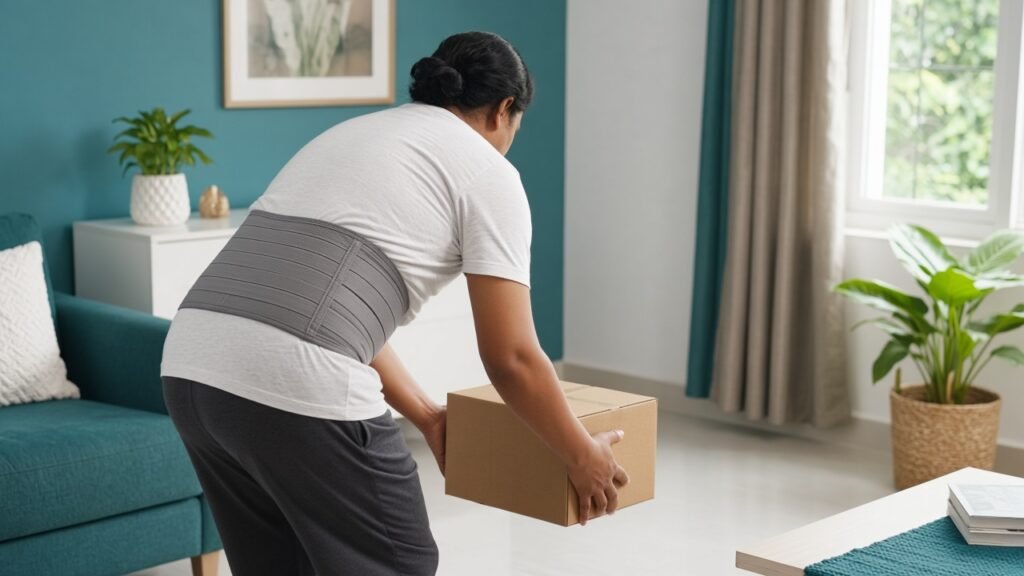
Lifting with a belt on
If you have to lift something while your back is sore, technique matters more than the belt. MedlinePlus, from the US National Library of Medicine, advises standing close to the object with your feet about shoulder width apart, bending at your knees rather than your waist, holding the load close to your body, and not twisting while you lift or carry (MedlinePlus). If something feels too heavy or awkward, get help.
How long should you wear a lumbar sacro belt?
My simple rule for patients: wear it for the hard parts of the day, for days, not months.
- During a flare-up: put it on for travel, chores or work tasks that bring on the pain. Take it off when resting, lying down or relaxing at home
- As you improve: drop it for easy tasks first, then for longer stretches
- The goal: reaching for it only on a tough day, and then not at all
While you wean off, keep moving: short walks, gentle back mobility, and later strengthening for your hips, trunk and legs. My back pain guide explains how we approach this in physio, and The Real Reason Your Back Hurts is a good read if you want to understand your pain better.
If this sounds like the short term support you need, you can check the Flamingo Lumbar Sacro Belt on Amazon here. Remember to pick your size.
Who should skip it, or check with a doctor first
Please do not self-treat with a belt if any of these apply to you:
- Pain, tingling, weakness or numbness in both legs, loss of feeling around your genitals or bottom, or changes in bladder or bowel control. The NHS advises calling for emergency help straight away for these (NHS)
- Back pain with fever, light-headedness, severe tummy pain, unexplained weight loss, severe pain at night, or a history of cancer. Cleveland Clinic lists these as signs that need a healthcare provider (Cleveland Clinic)
- Pain after a fall or accident
- Pregnancy, recent abdominal or spine surgery, or a hernia, unless your own doctor has advised a belt
- Pain that is not getting better after a few weeks of sensible self-care
Simple buying checklist
- I know why I want the belt, and it is for short term use
- I have measured my waist at belly button level and matched the size chart
- I have selected my size (the link opens on small)
- I will wear it over a thin layer and loosen it if it feels too tight
- I have a plan to walk and exercise, and to wean off it
Flamingo belt or Tynor belt?
Both are LS belts with back support and adjustable compression. My guide to the Tynor Lumbo Sacral Belt goes deeper into when a belt makes sense at all. The safe-use rules are the same for both: right size, right position, short term, paired with movement.
Quick FAQ
Will it fix my sciatica or slipped disc?
No belt can do that. Some people find it makes movement feel more comfortable for a while. If you have leg pain, numbness or weakness, get assessed.
Should I wear it to the gym?
This is a medical support belt for daily activities, not a weightlifting belt. If lifting at the gym hurts your back, get it checked and adjust your training.
Is it okay to sleep in it?
For ordinary back pain, I advise taking it off at night unless a doctor has told you otherwise.
My verdict
The Flamingo Lumbar Sacro Belt is a simple, practical choice if you want short term support during a flare-up of ordinary lower back pain. The splints and dual straps give you control over how firm it feels. Choose the right size, wear it in the right place, keep it for the hard parts of the day, and wean off as you get better. Your own muscles are the support you want in the long run.
If that fits your situation, view the Flamingo Lumbar Sacro Belt on Amazon. And if your back pain keeps coming back, or you are not sure a belt is right for you, please book an assessment with me and we will work out a proper plan together.
Dr. Lakshay Sharma PT, BPT (Delhi University), MPT in Sports and Musculoskeletal Physiotherapy, Sports Rehab Certification (CSPR London). This article is for general information and does not replace a personal assessment by a qualified healthcare professional.